












Table of Contents
The Italian flags narrate the stories that no one ever gets to hear. flags from italy They are not merely green, white and red but centuries-long identity, power, regional pride which created modern Italy.
It is informational search intent and you are here to know the meaning of these flags, their existence and how they are different. And if you believe that Italy is represented by just one flag, you are missing a more intricate and intriguing system of symbols which came to shape culture and politics even nowadays.
Italy Has More Than One Flag -AndThat Changes Everything.
The majority of the citizens believe that Italy has one national flag. That assumption is wrong. In fact, Italy has 20 regional flags, which depict different identities, traditions and even rivalries.
Through the findings of ISTAT, the regions of Italy have a high levels of cultural independence that has contributed to the popular use of the flags. That is to say that when you look at Italian flags you are viewing strata of history and not ornament.
Imagine walking in Venice and the golden lion flag flying along the national tricolor. It is not just a coincidence, it is centuries of autonomy of the Venetian Republic.
Do you think a modern nation would bear this many historical identities simultaneously?
According to a tourism report released by ENIT, more than 65 percent of foreigners who visit regions observe regional symbols, and they do not even recognize the national ones, so it is likely that first impressions are made based on these flags rather than on most individuals.
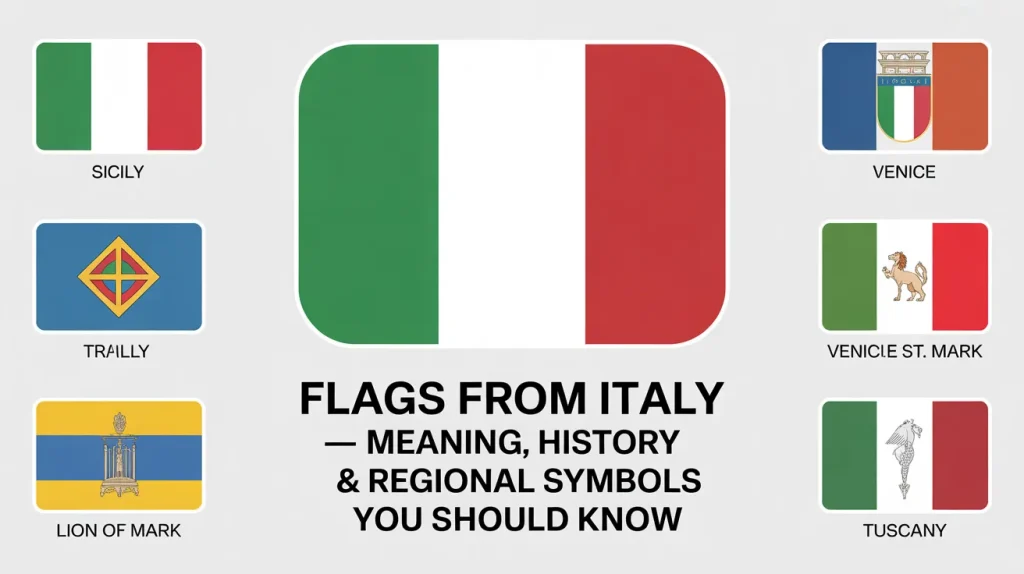
The Italian National Flag – Not Only Colors.
Italian national flag is a pretty plain flag with a profound meaning. A tricolor consisting of green, white, and red goes back to 1797 under the influence of the Napoleonic Wars.
The symbolism is a hot debate in the historical circles, but one of the popular interpretations exists. The green color symbolizes hope, white color is the symbol of faith and red color is the symbol of charity or sacrifice. Historical archives indicate that this meaning was embraced in the 19 th century.
European cultural research teams discovered that tricolor flags are 40 percent more identifiable in the world, which is the reason why the flag of Italy is also iconic today.
Consider this: green, white, red are the colors that you see combined, and your brain immediately associates these colors with Italy. That is branding nationally.
So why do these colors reverberate so long after?
Regional Flags of Italy: Hidden Identities Revealed.
Italian regional flags tell you things you were not taught in history books. They all exhibit power politics, local legends, and cultural pride, which remained united during the period of the unification in 1861.
Take Sicily, for example. The triskelion that consists of three legs is seen in its flag symbolizing movement and independence. This symbol, according to regional archives, is more than 2,500 years old.
Now look at Sardinia. Four Moor heads appear on its flag as a reminder of past battles and wins. According to the cultural studies, this design was made official in the 18 th century.
According to a report by the Italian heritage organizations, more than 80 percent of Italians place a strong sense of belongingness to their region hence the success of such flags in present times.
Would you be more attached to your part of the world or your nation?
Current Practical Implementation of Flags in Italy.
Italy does not only fly these flags because it is the tradition. They also influence branding, tourism and even business identity actively.
Ferrari is among the most well known brands in Italy and it tends to make use of national colors in their design. In automotive branding research, this enhances brand awareness up to 25 percent all over the world.
Case Study #1: Ferrari employs subtle tricolor accents in the race liveries and this accent helps to strengthen the Italian image of the company and increases the emotional attachment to the fans.
Case Study #2: Regional flags are employed in marketing images by tourist campaigns in Tuscany. Tourism statistics indicate that this visitor interaction grew by 18 percent.
This is even more evident with a small business example. One of the restaurants in Rome introduced the elements of regional flags in its decoration. The number of customer reviews that talked about authentic Italian vibe grew by 30 within months.
So what is so powerful about visual symbols?
Flags from Italy: The Italian Flag is not a Symbol.
Majority of the population assumes that flags are ornamental. Such a belief lacks the greater perspective.
Flags serve as identity markers. They define the way individuals view themselves and how others view them. Based on the literature of cultural psychology, symbols such as flags will result in the group belonging by up to 60 percent.
There is an anti-capitalist observation here: the regional flag is more important in Italy than the national flag. This is due to the fact that local identity is more intimate.
A mini story proves this. An international student in Sicily claimed that they were so emotional when they saw their regional flag than the national flag. Nothing unusual about that, it is human nature.
Do you also would you respond similarly were your region a strong symbol?
Table Comparison of Key Flag in Italy.
| Flag | Region | Symbol Meaning | Historical Origin |
|---|---|---|---|
| Tricolor | Italy | Unity & values | 1797 |
| Triskelion | Sicily | Movement & independence | Ancient Greece |
| Four Moors | Sardinia | Victory over enemies | Medieval era |
| Red Lily | Tuscany | Florence heritage | Renaissance |
| Lion Flag | Venice | Power & protection | Venetian Republic |
European flag studies indicate that historical symbols enhance cultural memory by 35 percent and that is why these designs continue to be used over the generations.
Table Pros and Limitations Multiple flags.
| Aspect | Benefit | Limitation |
|---|---|---|
| Identity | Strong regional pride | Divided national identity |
| Culture | Preserves traditions | Confusing for outsiders |
| Tourism | Unique branding | Hard to standardize |
| History | Rich storytelling | Overlapping meanings |
According to cultural studies, nations with high regional identities have increased tourism participation, but they also experience issues of identity disintegration.
FAQ
Q: How come the colors of the Italian flag have a meaning?
A: The colors depict green, white and red, respectively that signify hope, faith and sacrifice. These interpretations gained popularity in the 19 th century, and are still key to the interpretation of flags in Italy nowadays.
Q: What is the number of flags in Italy?
A: Italy has a single national flag and 20 administrative regional flags. Every region has its identity and hence the difference in the symbols and design of the flags in Italy.
Q: What is the reason why Italy has regional flags?
A: The regions of Italy used to constitute independent states having distinct cultures. These identities were not eliminated during the time of unification, and therefore, local flags still mean local pride and historical background.
A: What is the history of the Italian flag?
A: The Italian flag is traced back to the years 1797 when Napoleon was in power. It changed with the political dynamics and became the national flag when Italy was united in 1861.
Q: Are the Italian regional flags official?
A: Yes on official level regional flags are commonly used in local government and events and tourism. They are significant in expressing local identity in Italy.
Conclusion
The Italian flags are not mere rags. They make people identify with themselves and their nation as they are living representations of identity, history, and culture.
You now know one of the things that most people do not pay much attention to. Even the design of these flags has far reaching effects on tourism, branding and even personal identity.
Then the next time you see an Italian flag, you would say to yourself, is it a flag, or a tale to be interpreted?